
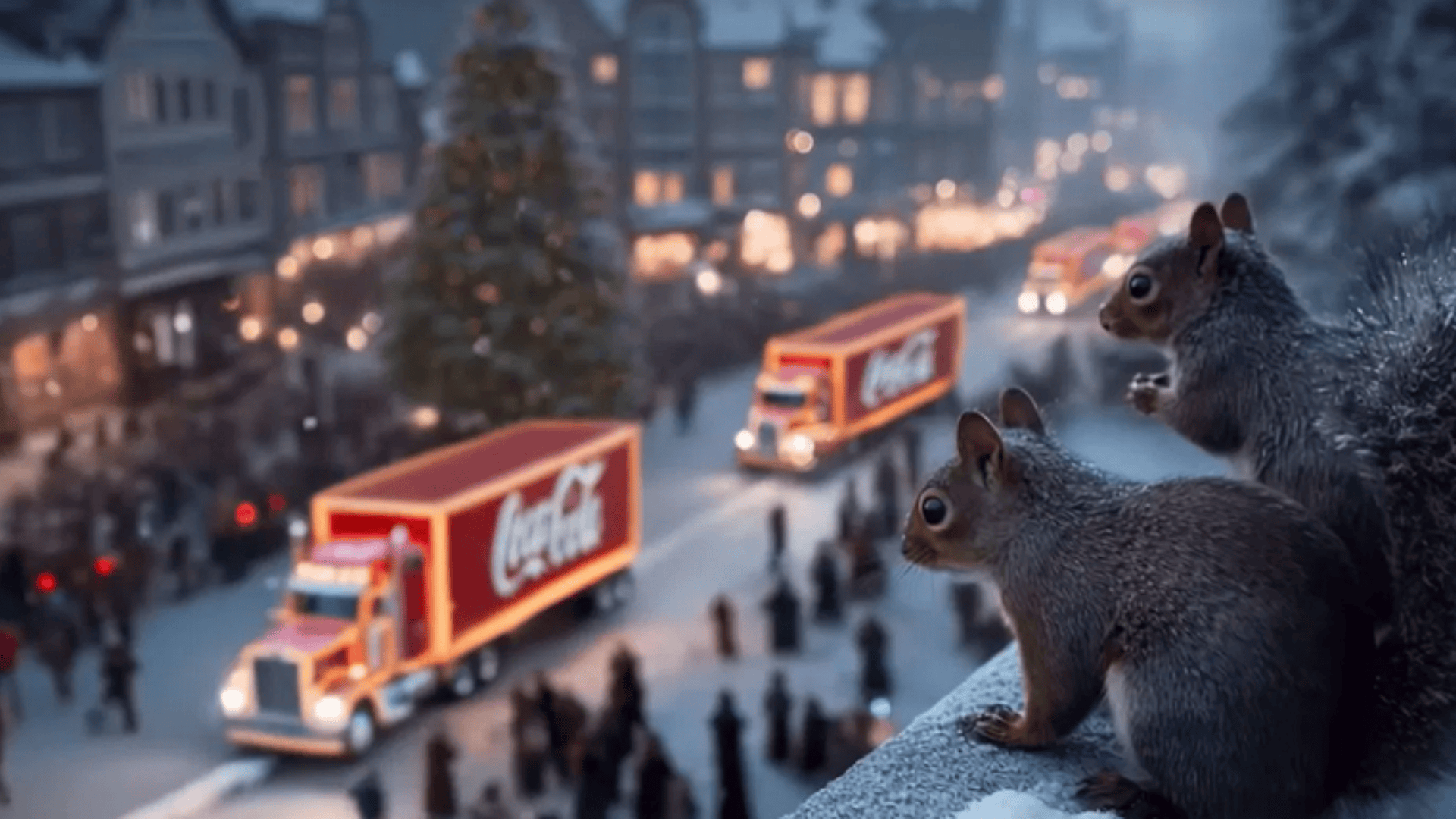
🤖🍿 Did Coca-Cola’s AI Christmas Ad Spoil the Holiday Magic? Why the Internet Is Divided (And What Your Business Needs to Learn)
Hey there! If you’re in marketing, tech, or just love a good cultural debate, you’ve probably heard about the recent commotion surrounding Coca-Cola’s AI-Generated Christmas Ad.
Every year, the sight of those glowing red trucks and the jingle, “Holidays Are Coming,” signals the start of the festive season. It’s pure, nostalgic magic. But recently, Coca-Cola decided to swap their traditional human production crew for Generative AI.
The result? A massive, viral controversy that split the internet right down the middle.
This isn't just about an ad; it's a peek into the messy, exciting, and sometimes scary future of Generative AI in Marketing. Let's grab a hot chocolate and break down what happened, why people were so upset, and what the five biggest lessons are for your business as you start using AI.
🧐 The AI Experiment: What Did Coke Actually Do?
Coca-Cola, a master of emotional branding, teamed up with tech studios to reimagine their iconic, decades-old Christmas truck campaign using cutting-edge AI models.
The Goal: To honor the tradition but showcase innovation. They wanted to prove that AI could create global-scale, high-quality, emotionally resonant content faster than ever. What used to take a year could now be done in mere months, saving huge amounts of time and budget.
The Outcome: Technical success, but cultural confusion.
While the AI-generated visuals were detailed and looked like the Coke world, the ad immediately became a lightning rod for two very distinct groups:
📢 Camp 1: The AI Skeptics (The "Soul" Defenders)
These were the artists, animators, and many everyday viewers. Their critique was visceral:
The Uncanny Valley: They found the visuals "creepy," "soulless," and "lifeless." The human figures, in particular, looked almost right, but subtly wrong—the famous Uncanny Valley effect.
The Job Fear: This was the emotional core of the backlash. As one critic famously joked, the red on the Coca-Cola truck was “made from the blood of out-of-work artists.” People saw this as a huge brand prioritizing cheap AI over human creativity.
The Authenticity Crisis: How can a company’s tagline be “Real Magic” when the content is clearly machine-generated? The technology seemed to contradict the brand’s entire ethos.
🚀 Camp 2: The AI Enthusiasts (The "Efficiency" Advocates)
These were the tech consultants, some industry marketers, and the brand itself. They saw the ad as a triumph:
Innovation: They praised Coke for being a global leader, embracing Digital Transformation, and pushing the boundaries of what's possible.
Speed & Scale: Two months for a global campaign? That's unprecedented efficiency! AI delivered results that saved massive amounts of production cost and time.
Inevitable Progress: They argued that AI is here to stay, and brands must adapt or risk becoming obsolete.
The Takeaway: Coca-Cola successfully proved AI can make an ad. But they painfully discovered that just because you can do something doesn't mean you should, especially when dealing with nostalgia and deep-seated cultural assets.
💔 3 Critical Fault Lines Exposed by the Controversy
The division wasn't random. It exposed three core conflicts every business must navigate when implementing Ethical AI.
1. The "Real Magic" Paradox: Authenticity vs. Efficiency
The biggest strategic flaw was the head-on collision between the method and the message.
The Magic: Coca-Cola is all about tradition, human warmth, and emotional connection.
The Method: Cold, fast algorithms used to replace human artistry.
Here’s the thing: When you use AI to replace a high-value, high-emotion piece of content, the audience feels it. They might not understand the coding, but they sense the lack of human hands, heart, and soul in the final product. For a brand like Coke, whose equity is built on emotional sincerity, prioritizing efficiency over authenticity was a huge gamble that didn't pay off.
2. The Uncanny Valley in Nostalgia
AI is getting incredible, but it's still imperfect. It struggles with the nuances of genuine human emotion.
When you ask AI to recreate a beloved classic, any visual imperfection—a slightly distorted face, unnaturally smooth movement, or a weird texture—is amplified tenfold. Why? Because the audience has a perfect, heartfelt memory of the original.
Our brain screams: “This is not the Christmas magic I remember!”
The lesson is simple: Be extra cautious deploying AI on assets tied to deep audience nostalgia. Start with new, original concepts where there are no pre-existing emotional benchmarks.
3. The Ethical Echo Chamber
Timing matters. The ad arrived during a period of massive layoffs and anxiety in the creative industries, with AI often cited as the cause.
Coke’s move wasn't just using AI; it was celebrating the use of AI to cut production time—and by implication, labor costs. This was seen as a corporate slap in the face to the very artists they’d relied on for decades.
The key ethical question: If you’re going to be transparent about using AI (which you should be!), do you frame it as a tool that replaces human jobs or a tool that augments human capabilities? The framing matters more than the technology itself.
💡 5 Essential Lessons for Your AI Marketing Strategy
You can’t afford to ignore AI, but you also can’t afford to make Coca-Cola’s mistakes. Here’s a quick blueprint for a smart, responsible, and effective Digital Transformation using Generative AI:
1. Prioritize Augmentation Over Automation (The Human Veto)
Don't let AI handle the final, customer-facing 10%. Use AI for 80% of the heavy lifting: storyboarding, generating 100 script variations, or prototyping. Then, let human creatives apply the final 20% of finesse and soul. A human must always have the final veto on emotional content.
2. AI Must Serve the Strategy, Not Be the Story
If the first thing people talk about is the technology you used (e.g., "It's the AI ad!"), you've failed. The story should always be about your brand's message and value. The technology should be the quiet, powerful engine that makes that message more efficient, targeted, or personalized.
3. Start with Invisible AI
Don't use your biggest, most emotional brand asset as your pilot project! Start by using AI where the customer doesn't directly see it:
Dynamic Creative Optimization: Using AI to assemble different ad components for specific user segments.
Media Buying & Forecasting: Letting AI predict which channels and times are most effective.
Internal Asset Generation: Creating quick drafts for internal communications or placeholders.
4. Transparency Requires Sensitivity
Be transparent about using AI, but frame the conversation positively. Instead of saying, “We cut production time by a year,” say, “We freed up our world-class human designers to focus on high-level strategy by leveraging AI for iterative tasks.” Highlight how AI creates new, complex roles for humans (like prompt engineers and AI auditors).
5. Assess the Brand Equity Risk
Before launching any major AI campaign, ask your team: "Does the use of this technology reinforce our brand values or contradict them?" If your brand is built on craftsmanship, human connection, or handmade products, fully automated AI visuals are a severe brand risk. Adjust accordingly!
🔮 What’s Next for the Magic?
The Coca-Cola AI ad was a painful, yet necessary, turning point. It showed us that we're moving past the "Can we do it?" stage of AI and firmly into the "Should we do it?" stage.
The future of marketing success won't belong to the brands that use the most AI, but to the brands that use AI the wisest. The real "magic" lies in knowing when to hit the gas on automation and, more importantly, when to step on the brakes and let the human heart take the wheel.
What do you think? Did the ad ruin your holiday spirit, or do you think the critics are just being Luddites? Let's keep the conversation going in the comments! 👇